Songs for California, Poems of the Golden State
Songs for California, Poems of the Golden State
Couldn't load pickup availability
View full details
About the Book
Songs for California, Poems of the Golden State is the final poetry collection by Jack D. Forbes (1934–2011), a leading Indigenous scholar, activist, and founding figure in Native American and Indigenous Studies. Composed over many years, this volume is a poetic meditation on place, memory, and Indigenous survivance, offering a verse autobiography grounded in the landscapes and social histories of California.
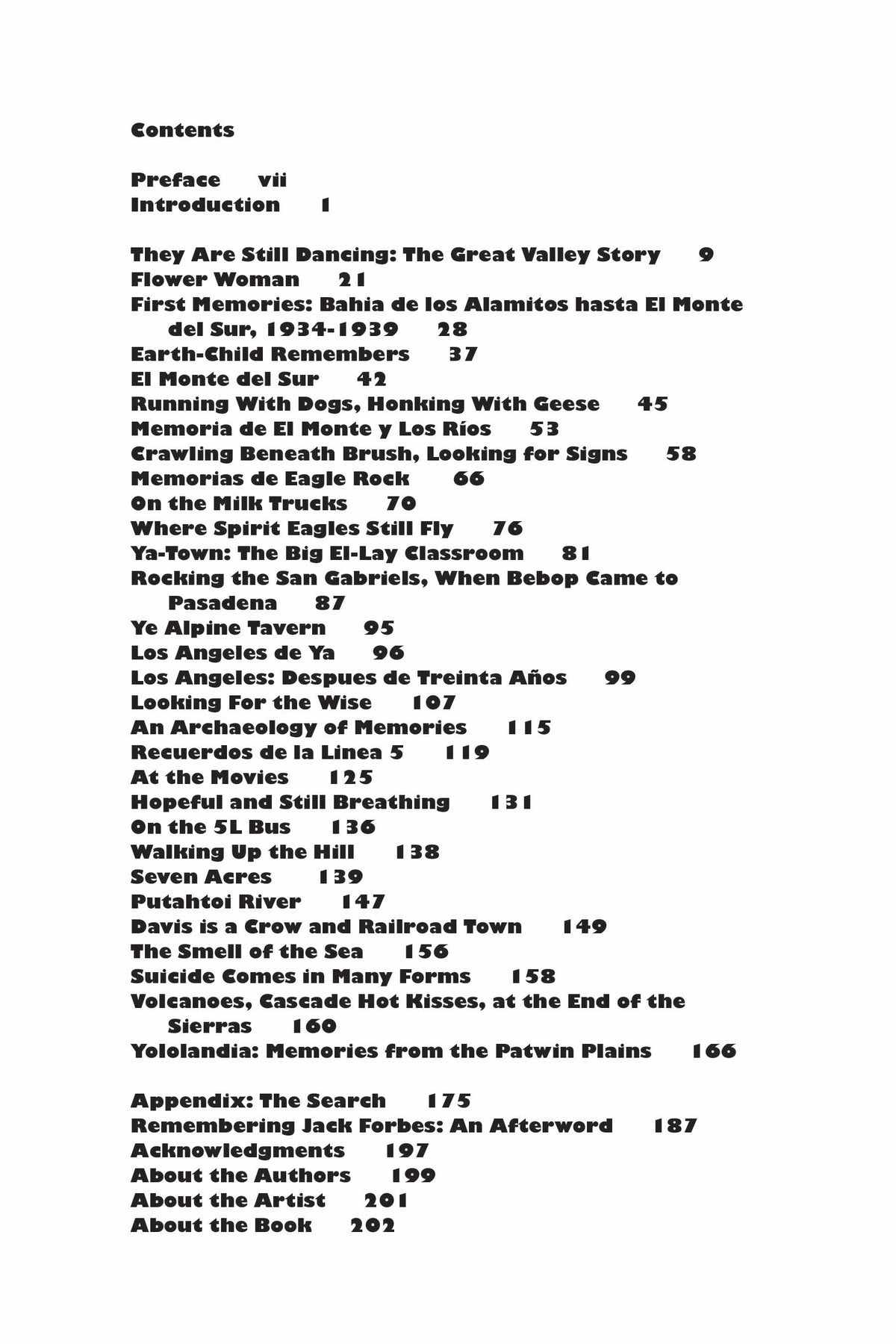
The poems trace Forbes’s life from his childhood in El Monte, Eagle Rock, and Los Angeles to his later years in Northern California, interweaving personal narrative with reflections on Indigenous presence, ecological change, urban transformation, and colonial violence. The collection opens with the long historical poem “They Are Still Dancing: The Great Valley Story,” which foregrounds California’s Indigenous cultures prior to colonization and affirms their resilience in the face of attempted genocide and dispossession. The closing poem, “Yololandia,” returns to Northern California and the Patwin homelands, framing the collection within a broad arc of Indigenous history and place-based knowledge.
Forbes’s poetry may be read alongside the work of Indigenous poets such as Joy Harjo, Simon J. Ortiz, Gloria Bird, and Kimberly Blaeser, whose writing similarly blends personal narrative, history, and political critique. Like these writers, Forbes uses poetry as a mode of Indigenous knowledge production rooted in oral traditions, testimony, and relational ethics. His work is distinguished, however, by its sustained engagement with California as both lived geography and intellectual construct, and by its integration of autobiographical memory with Indigenous historiography.
Edited by Jane Haladay, a former student and colleague of Forbes, Songs for California preserves the poet’s distinctive formal and stylistic choices while making minimal editorial interventions. The volume highlights poetry as an alternative to conventional academic discourse, demonstrating how Forbes turned to verse to articulate forms of historical, cultural, and personal knowledge that exceed the constraints of scholarly prose.
Songs for California makes a significant contribution to Indigenous literary studies, California history, environmental humanities, and life writing. It stands as an important posthumous work that affirms poetry’s capacity to bear witness, sustain cultural memory, and articulate enduring relationships between people, land, and history.
Jack D. Forbes is an internationally acclaimed writer, scholar, educator, and activist of Powhatan-Renapé and Delaware-Lenápe heritage. Born in Long Beach, California on January 7, 1934, Jack spent his childhood and youth in El Monte, Eagle Rock, and Los Angeles. Throughout his lifetime, Jack advocated forcefully for Indigenous sovereignty, self-determination, education, and environmental and human rights. Jack earned his bachelor’s degree in philosophy in 1955, his master’s degree in history in 1956, and his PhD in history and anthropology in 1959, all from the University of Southern California. He joined the faculty at the University of California at Davis in 1969, where the Native American Studies program was established the same year through his vision and leadership. In 1971, Jack and David Risling (Hoopa) created Degoniwida-Quetzalcoatl University (D-Q U) in Winters, which was the first college in California exclusively for Native Americans. The scope and diversity of Jack’s writing and scholarship are vast and include the books Apache, Navaho and Spaniard (1960 and 1994), Columbus and Other Cannibals (1992), Africans and Native Americans (1993), Only Approved Indians (1995), Red Blood: A Novel (1997), and The American Discovery of Europe (2007), as well as monographs, editorials, and many poems in addition to those published in Songs for California. In addition to his teaching at UC Davis, Jack taught internationally as a Fulbright scholar and visiting lecturer and mentored generations of undergraduates, graduate students, and faculty in the discipline of Native American Studies. Jack passed at the age of 77 in Davis, California.
Jane Haladay was born and raised in San Gabriel, California, homelands of the historical and present Tongva Nation. She is a settler scholar and Professor of American Indian Studies at the University of North Carolina at Pembroke, in the heart of the Lumbee Indian Nation. Jane teaches Native American literature and other Native Studies courses that incorporate service learning, writing enrichment, and international Indigenous travel study. Much of her research and teaching focuses on Indigenous women’s literature and collaborative pedagogy. She has published a range of critical and creative work, including in the journals Studies in American Indian Literatures, North Carolina Literary Review, Reflections: Public Rhetoric, Civic Writing, and Service-Learning, Teacher-Scholar: The Journal of the State Comprehensive University, Wicazo Sa Review, Interdisciplinary Studies in Literature and Environment, and Life Writing. Her co-edited collection, with Dr. Scott Hicks, on the challenges of university sustainability education is Narratives of Educating for Sustainability in Unsustainable Environments (Michigan State University Press, 2017). Among other recognitions, Jane has received UNCP’s Diane O. Jones Excellence in Service-Learning Award (2016), the Outstanding Allyship Award from UNCP’s American Indian Heritage Center (2021), the Randall Keanan Prize (2023), and the University of North Carolina 200 | Songs for California
Board of Governor’s Award for Excellence in Undergraduate Teaching (2023). Jane is a poet, a gardener, and a former high school English teacher at San Mateo High School, California, in the San Francisco Bay Area.
Hartmut Lutz was born in Rendsburg, Schleswig-Holstein, three months after the liberation of Auschwitz and twelve days before the armistice ended the German Nazi terror. After school, he first worked with mentally impaired people in England and Sweden and then obtained a teaching degree at Pädagogische Hochschule Kiel, including two semesters at SUNY Fredonia. His doctorate (Tübingen) was on psychoanalysis and literature, William Goldings Prosawerk (1975), his Habilitation (Osnabrück) on Indian stereotyping in U.S. and German cultures, “Indianer” und “Native Americans” (1985). He first taught English Literature and then North American Literatures and Cultures, focusing on works by Indigenous authors. He coined the term “Indianthusiasm” (Indianertümelei) for the German (and others’) romanticizing fascination with “Indians.” After working at the universities of Cologne and Osnabrück in West Germany, he chaired North American Literatures and Cultures at the University of Greifswald until his mandatory retirement in 2011, when he accepted for one year a professorship in North American Studies at the University of Szczecin (Poland). Throughout his career, years of sponsored research and multiple guest professorships took Hartmut to Canada, Denmark, Finland, Iceland, Poland, Romania, Spain, and the United States. Among his many books are: D-Q University (1980), Minority Literatures in North America (1989), Contemporary Challenges: Conversations with Canadian Native Authors (Saskatoon 1991), Connections (Delhi 2003), The Diary of Abraham Ulrikab (Ottawa, 2005), Howard Adams ‘Otapaway’ (Saskatoon, 2005), Contemporary Achievements (2015), and most recently Indianthusiasm: Indigenous Responses (Waterloo, ON 2020). His autobiographical Turtle Island Memories will come out in Ottawa in 2026. His awards include Fulbright-, ACLS-, and DAAD-fellowships, the Harris Chair (Dartmouth College), and the Canadian Government’s Diefenbaker Award (Ottawa U). In 1921, Hartmut Lutz was inducted as an International Fellow of the Royal Society of Canada for his pioneering work “in the field of Indigenous literary studies in Canada and the US.”
Genevra Munoa is a multidisciplinary artist from the Pechanga Band of Indians of the Payómkawichum people, born and raised in San Diego, California. Grounded in the landscapes of land and ocean, her work reflects a deep connection to place and community. She works across illustration, fiber tufting, watercolor, and linocut print, among other mediums, embracing an expansive and tactile creative practice. She holds a Master of Education in Learning, Diversity, and Urban Studies from Vanderbilt University and a Bachelor of Science in Sociology from Brigham Young University. Munoa’s practice weaves together sociology and art as a means of exploring and communicating complex, often difficult histories and lived experiences. As an arts educator of over five years, she is committed to using creative work as a tool for education, centering the voices and experiences of Indigenous Californians. Genevramunoa.com | genevramunoa@gmail.com